
Romance Scams
Romance Scams: Building emotional trust through friendly texts and calls, or fake dating profiles,…
Romance Scams: Building emotional trust through friendly texts and calls, or fake dating profiles, to eventually request assistance by asking for money or other financial assets.
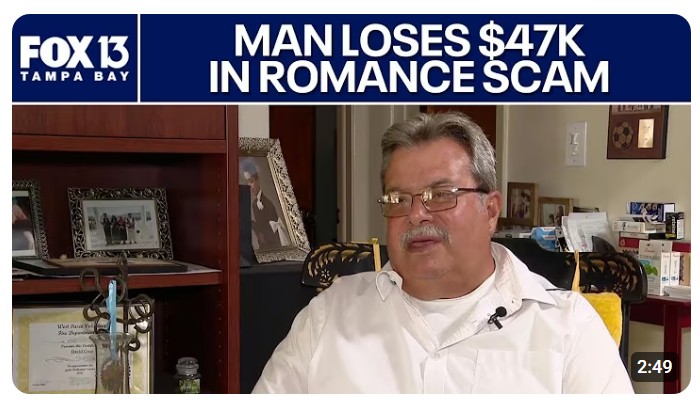
AARP – Article regarding Romance Scams

Recent Headlines and Stories
Thousands of individuals have found love virtually. Many of these lucky couples have progressed in their relationships and eventually marry. However, meeting people online comes with obvious risks. If a scammer uses the anonymity of the internet to create fake profiles and personas, they can take advantage those innocently looking for romance.
Since these scams are typically not reported, due to their embarrassing nature. it’s difficult to determine the number of victims who have suffered at the hands of romance fraudsters.
AARP’s recent romance scams survey of more than 1,000 American adults age 50 and older found that 1 in 10 respondents reported having interacted with a potential romantic partner online who eventually requested money or encouraged them to invest in cryptocurrency.
According to the Federal Trade Commission (FTC) in 2024, nearly 60,000 people reported romance scams. According to AARP’s article, Romance Scams are a subcategory of impostor scams, to which victims reported losing a jaw-dropping $2.95 billion that year. (AARP)
The Lies Romance Scammers Tell
According to the FTC, Romance scammers adjust their story to what they think will work in each situation. Scammers may say they can’t meet you in person, but then at the last minute are unable to meet. They might say they’re living or traveling outside the country, “working on an oil rig, in the military, or working with an international organization.” Then, scammers will ask you for money to help them get back home, or to assist financially with transportation, housing or other event they are experiencing while on-the-road.
Fraudsters will first use manipulation to gain your trust, then they may ask for your help to pay medical or auto expenses or even to purchase a travel ticket to visit you. Scammers will tell you “how” to pay the money, who to send it to, etc.
Most all scammers, not just romance scammers, use URGENT words so they can get your money as quickly as possible, before you are able to identify the scam. They also usually request that you send the money in a format or process that creates a difficult way for you track, or get the funds returned to you. They may ask you to wire money through a company like Western Union or MoneyGram, send the money on gift cards (like Amazon, Google Play, iTunes, or Steam), or to send money through a money transfer app, or even transfer the funds with cryptocurrency. Scammers do these things to pressure you into acting urgently and immediately.
Other Red Flags for Romance Scams:
- The Broken Camera/No-Show Excuse: They refuse to video chat, claiming a broken camera or video application, or make a variety of excuses to avoid meeting at a cafe or restaurant (in person).
- Love Bombing: The scammer showers you with extreme affection, compliments, and promises of marriage very early in the relationship, manipulating your emotions. This type of manipulation causes us to bypass caution, especially if we are lonely or over-trusting.
- The Extortion Scam: Scammers may ask you to send intimate photos of yourself, since they “miss you,” or sexually compromising videos, which they then use to blackmail you for money, threatening to release them to your friends and family. This is used especially if you have a large social media following or have a high-profile job title. As soon as the scammer understands that your privacy is crucial, they use anything they have learned during your conversations against you.
- The “Trusted Friend” Scam: They may ask you to receive money into your bank account and transfer it to a trusted friend or co-worker, who is acting as a money mule to launder the stolen funds from another entity.
WHAT YOU CAN DO TO PROTECT YOURSELF
- Research the person’s photo and profile using online searches to see if the image, name, or details have been used elsewhere.
- Go slowly and ask lots of questions.
- Always do a reverse image search on their profile pictures to see if they are stolen.
- Insist on a live video call to verify their identity.
- Be careful what you post and make public online. Scammers can use details shared on social media and dating sites to better understand and target you.
- Beware if the individual seems too perfect or quickly asks you to leave a dating service or social media site to communicate directly.
- Beware if the individual attempts to isolate you from friends and family or requests inappropriate photos or financial information that could later be used to extort you.
- Beware if the individual promises to meet in person but then always comes up with an excuse why he or she can’t. If you haven’t met the person after a few months, for whatever reason, you have good reason to be suspicious.
- Never send money, cryptocurrency, or gift cards to someone you have not met in person.
- Never send money to anyone you have only communicated with online or by phone.